
What should you expect from the Austin housing market and Austin economy in 2026—and how should that shape your real estate decisions?
Last week, we attended the Austin Business Journal's 2026 Economic Outlook presentation at the JW Marriott downtown. It focused on the Austin economy as whole, and that's exactly the type of macro view we want as we try to understand what's ahead in the local real estate market.
In short: 2026 looks steadier than 2025. The Austin housing market is moving from volatility to consistency, the Austin economy is investing for growth, and your results will hinge less on speed and more on strategy - pricing, negotiation, and timing.
2026 > 2025: Momentum Returns (Without the Whiplash)
The throughline from the Austin Business Journal’s 2026 Economic Outlook: plans that paused are restarting. Leaders aren’t waiting for a “perfect” signal anymore. That shows up across the Austin real estate landscape as steadier sales cycles, measured pricing by submarket, and renewed project activity in infrastructure and capacity - exactly what you want when you’re aiming for clarity over drama in the Austin housing market.
Housing Recap: How 2025 Set Up a More Predictable 2026
Unlock MLS Research (presented by Emily Girard and aligned with Vaike O’Grady’s “Housing Trends in 2026” flyer) framed late 2025 as the point where stability replaced volatility and the market “found its footing.”
December 2025 Housing Stats
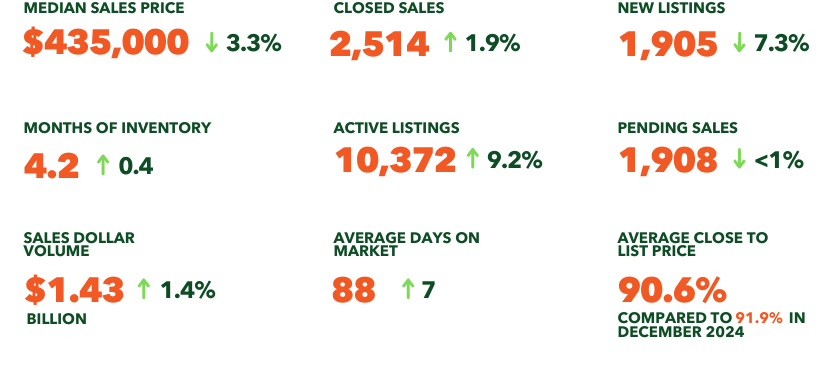 Chart showing Austin December 2025 housing stats
- Closed sales (Dec 2025): 2,514 (+1.9% YoY)
- Median sales price: $435,000 (–3.3% YoY)
- Close-to-original list ratio (avg): 90.6%
- Pendings: roughly flat
- Days on Market: higher than the frenzy years
- Inventory: back in a more balanced range—choice is back
Source: Unlock MLS Research “Housing Trends in 2026” (Vaike O’Grady); remarks presented via ABOR/Unlock MLS framing at the Austin Business Journal 2026 Economic Outlook.
Why This Matters for You
- You can compare options again. More inventory means you can evaluate tradeoffs and pick what truly fits (location, layout, commute, timeline).
- Pricing matters. Sellers who price to the market earn attention; buyers who respect the data win more often - without overpaying.
- Negotiation is back. With the average sale at ~90.6% of original list, there’s room to negotiate - provided your strategy is grounded in current comps, condition, and days on market.
2026 Housing Playbook: Consistency, Not Correction
Expect 2026 to reward process over urgency:
- More predictable sales cycles. Fewer abrupt shifts, more recognizable seasonal patterns.
- Moderate, submarket-specific price movement. Not every area moves in lockstep; local nuance matters.
- Fewer sharp resets. You’ll still see negotiation, but extremes are less common than they were during the rate spikes.
Bottom line for your plan: if you’re buying, focus on readiness (pre-approval, search criteria, inspection strategy). If you’re selling, focus on pricing strategy, presentation, and timing to hit the right micro-window in your submarket.
Infrastructure & Mobility: The “Slow Burn” That Supports Long-Term Confidence
From the regional mobility authority’s update, the theme was steady progress:
- 183 toll lanes: close to opening
- 290: potential expansion east toward Elgin
- South MoPac: studying toll-lane expansion south to Slaughter
This isn’t an overnight headline - it’s a capacity story. As projects phase in, the region’s circulation improves, which supports long-term confidence for employers, commuters, and yes, housing demand.
Source: Regional mobility authority remarks, Austin Business Journal 2026 Economic Outlook.
Macro Outlook: Why the Austin Economy Looks Constructive for 2026
Keynote framed the big picture (David Spika, Turtle Creek Wealth Advisors):
- Texas growth remains solid. Employment is still healthy, supporting consumer spending.
- Rates remain the governor on housing transactions. As rate volatility cools, activity stabilizes.
- Consumers are less confident in the US dollar. Gold is up. Way up.
- AI is a major capex driver. Data centers and power generation are second-order beneficiaries that feed construction, trades, and specialized services.
- Energy & utilities matter. Input costs ripple into site selection and operating decisions.
- Policy clarity helps. Less whiplash in 2026 means more green lights for projects already on the drawing board.
Attribution: Macro remarks, Austin Business Journal 2026 Economic Outlook (David Spika).
Air Travel & Economic Capacity: Planning for the Next Decade
Panel insights (moderated by Colin Pope) underlined the region’s long-horizon stance:
- Consumer sentiment: roughly one-third optimistic, one-third pessimistic, one-third neutral; locally, many expect their personal finances to improve in 2026.
- Workforce pipeline: Austin Community College’s typical learner is around 27, often balancing family responsibilities and two part-time jobs, seeking a credential that improves income quickly - evidence of a workforce actively upskilling.
- Airport expansion: the 2018 study’s passenger projections were already hit (much sooner than expected), but the build plan is significant - usable improvements by ~2030, a plan to double gate capacity, and longer-term Concourses C, D, and E that add substantial capacity later.
- Airlines: major carriers (including Delta and American) are described as bullish on the Austin market.
Taken together, these are the kinds of signals that support sustained business investment - exactly the context that benefits residential demand over a multi-year horizon.
Attribution: Airport remarks and information credited to Ghizlane Badawi, Chief Executive Officer, Austin-Bergstrom International Airport; additional panel speakers: Dr. Eric Johnson, Assistant City Manager, City of Austin; and Dr. Russell Lowery-Hart, Chancellor, Austin Community College.
What This Means for Your 2026 Austin Real Estate Plan
Here’s how to translate the Austin housing market and Austin economy outlook into action:
- Define your window. With more predictable seasonality, choose a 6–12 week window that aligns with your financing and life timing.
- Price or offer to the data. Sellers: price to today’s comps and condition to maximize showings in week one. Buyers: anchor offers to micro-comp data (not last year’s headlines).
- Use negotiation intentionally. Expect counteroffers. Use inspection periods and concessions to solve real problems, not to renegotiate price without cause.
- Value choice. With inventory in a more balanced range, don’t force a fit; let options do the work.
- Plan for rates, not around them. If rates drift lower, that’s upside; if they don’t, you still acted in a functional market rather than waiting for a lightning bolt.
- Think in scenarios. Have a Plan A (base case), Plan B (rates lower, activity picks up), and Plan C (rates sticky, lean harder on pricing/credits).
Final Takeaway
If 2025 was the reset, 2026 is the rhythm. For Austin real estate, that means fewer abrupt shocks and more room for you to execute a plan that fits your timing - supported by a constructive Austin economy, steady mobility improvements, and a pipeline of capacity that points to sustained regional confidence.
Schedule Your 2026 Planning Call
If you’re buying or selling in 2026 (or mapping a move beyond), schedule a call to align pricing, timing, financing, and negotiation to your goals. Your plan will be built around current comps, submarket dynamics, and the specific constraints and opportunities you care about.